
Dallas is a city of pockets.
One of the first things to understand about Dallas is that it rarely feels like one continuous city.
A few miles can take you from estate streets beneath a mature tree canopy to a walkable neighborhood where dinner, coffee, and the Katy Trail are part of the daily routine. Cross town again and the experience changes—to historic homes and front porches in East Dallas, high-rise living near the urban core, or larger lots and quieter residential streets farther north.
For someone relocating here, that can make Dallas surprisingly difficult to understand from a map—or a list of homes.
The better place to begin is not “Which neighborhood is best?”
It is “How do I want to live in Dallas?”
That distinction will make almost every decision that follows easier.
Start broad. Then go deeper.
Dallas has dozens of named neighborhoods, and the distinctions matter. But if you are new to the city, trying to understand all of them at once is usually more confusing than helpful.
Start with the broader geography.
The Park Cities + Nearby, North Dallas, East Dallas, Central Dallas, and the city’s other major areas each establish a different relationship to work, schools, restaurants, green space, housing, and the rest of Dallas.
Once you understand those larger areas, individual neighborhoods begin to make much more sense.
Highland Park and University Park share many characteristics, but aren’t interchangeable. Preston Hollow can mean everything from winding estate streets and multi-acre properties to more traditional residential blocks. Lakewood’s relationship with White Rock Lake gives it a distinctly different rhythm from the M Streets just a few minutes away. Uptown and Knox may both offer more urban living, but they don’t deliver the same experience either.
The names become useful once you understand the geography behind them.
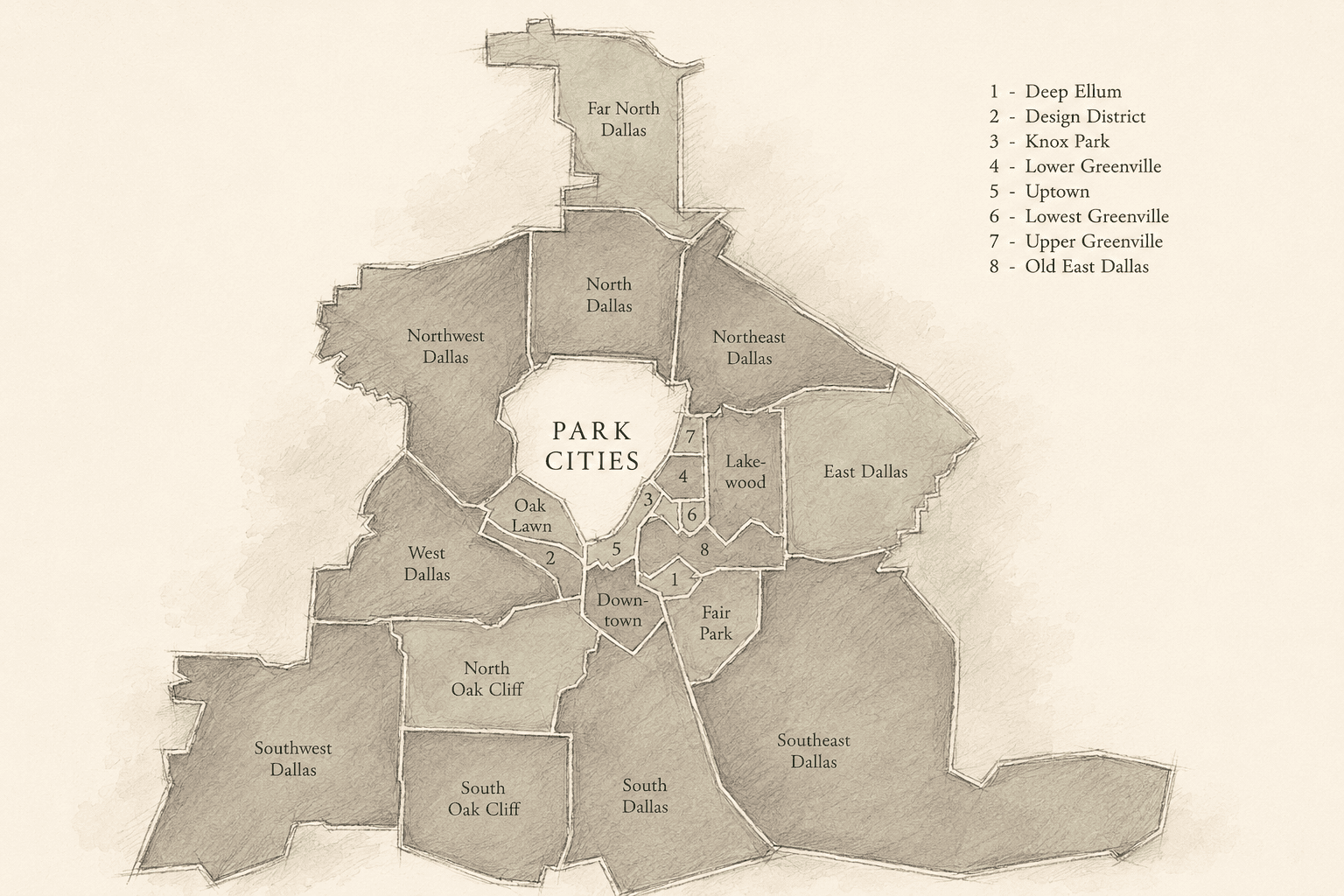
A few miles can change the way you live.
Dallas is a good example of why proximity alone doesn’t tell you very much about a neighborhood.
Consider four places that can all put you relatively close to the city’s core.
Highland Park offers an exceptionally manicured residential environment, its own municipal identity, HPISD, established architecture, and a village-like center around Highland Park Village.
Preston Hollow moves you toward larger properties, greater privacy, and some of Dallas’ most significant estate streets—while keeping the Park Cities, private schools, and major employment centers within reach.
Lakewood shifts the experience east, where White Rock Lake, mature trees, historic architecture, and a more relaxed neighborhood culture become part of everyday life.
Uptown changes the equation again: apartments and high-rises, restaurants, offices, trails, and considerably more of daily life within walking distance.
None is inherently better.
They are different answers to the same question:
What do you want everyday life in Dallas to feel like?
Start with the things you can’t move.
A beautiful kitchen can be renovated. A bathroom can be changed. Even a house that isn’t quite right may become right over time.
The location cannot.
Neither can the size of the lot, the school district, the commute corridor, or the basic relationship between your home and the places you use every day.
For that reason, I encourage people relocating to Dallas to think first about the characteristics that are difficult—or impossible—to recreate.
Do you want mature trees and architectural character? Do you want to walk to dinner? Is a large yard important, or would you rather have something you can lock and leave? Do you expect to spend weekends around White Rock Lake or the Katy Trail? Will school geography shape the search? How often will you travel through DFW or Love Field? And where will you actually be driving on a Tuesday morning?
Those questions often reveal more than a price range ever could.
In Dallas, your commute is part of your lifestyle.
Dallas is a driving city, but that doesn’t mean every Dallas commute is the same.
Two homes may appear similarly convenient on a map and produce very different daily routines depending on where you work, which roads connect you, when you travel, and how much flexibility you have.
That matters even more as Dallas’ employment geography continues to evolve. Downtown is no longer the single point around which every commute revolves. Uptown, Victory Park, the Dallas North Tollway corridor, Las Colinas, and other employment centers can create entirely different residential considerations.
Rather than asking only, “How many miles is this from the office?”, ask:
“What will this commute actually feel like?”
That is a question worth answering before you fall in love with a house.
Related Guide: A Newcomer’s Guide to Dallas Commutes.
Understand the Park Cities early.
Few pieces of Dallas geography confuse newcomers more consistently than the Park Cities.
Highland Park and University Park are independent municipalities surrounded by Dallas. Together, they are commonly referred to as the Park Cities, and both are served by the Highland Park Independent School District.
But Highland Park and University Park are not the same community—and nearby Dallas neighborhoods such as Bluffview, Devonshire, and Preston Hollow are not part of the Park Cities at all.
Those distinctions affect far more than what people call the neighborhood. They can affect schools, municipal services, taxes, housing, lot sizes, and the overall experience of living there.
If the Park Cities are likely to be part of your search, learn the geography before you begin comparing properties.
Related Guide: Understanding the Park Cities: Highland Park, University Park + What’s Nearby.
Don’t choose from a checklist alone.
Relocation searches naturally begin with criteria:
Four bedrooms.
Under 25 minutes to work.
Good schools.
A certain budget.
A yard.
Walkability.
Those things matter. But they don’t necessarily tell you where you’ll feel at home.
Dallas neighborhoods have personalities that are difficult to capture in a spreadsheet.
Some feel polished and established. Others are more relaxed. Some revolve around schools and neighborhood traditions; others around restaurants, trails, or cultural life. Some offer extraordinary houses, but very little you will walk to. Others trade land and privacy for convenience and energy.
You often don’t recognize those differences until you spend time in them.
So once you’ve narrowed the geography, get out of the car.
Walk around. Have coffee. Go to dinner. Drive the route to work. Visit at 8:00 in the morning and again on a Saturday afternoon.
A neighborhood should make sense on paper.
But ultimately, it also has to feel right.
Then start looking at houses.
This is the point where the home search becomes much more productive.
Instead of asking the entire Dallas market to tell you where you belong, you begin with a much smaller set of places that already align with the life you’re trying to build.
And then the conversation can become more nuanced.
Do you prefer Highland Park or University Park? Lakewood or the M Streets? The estate side of Preston Hollow, or something more connected to shops and restaurants? A high-rise near the urban core or a lock-and-leave home in an established residential neighborhood?
Those are better questions.
And Dallas becomes considerably easier to navigate once you know which ones you’re trying to answer
THE CURATED TAKE