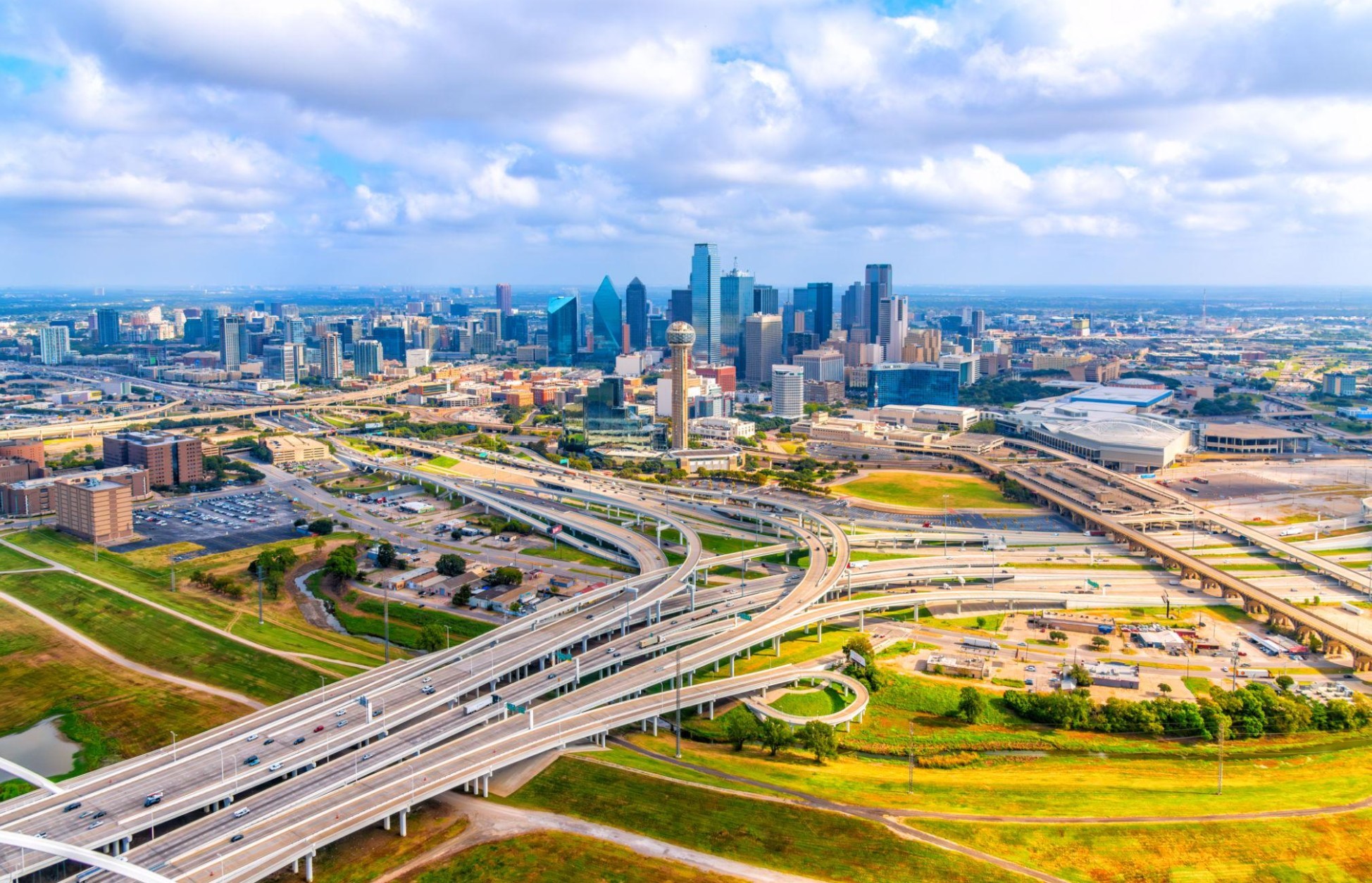
In Dallas, commute is part of lifestyle.
One of the easiest mistakes to make when relocating to Dallas is looking at a map, calculating the mileage between a house and an office, and assuming you understand the commute.
You probably don't.
Dallas is large, but size isn't really the issue. The city is organized around multiple employment centers, major highways and toll roads, and traffic patterns that can make two similarly distant homes feel very different Monday through Friday.
A ten-mile commute isn't always easier than a fifteen-mile one.
And a neighborhood that looks slightly farther away may actually provide the better daily routine.
Before choosing where to live, understand where you'll actually be going—and how you'll get there.
Dallas doesn't have one employment center.
For decades, newcomers could reasonably think of Downtown Dallas as the center of the city's business geography.
That's no longer sufficient.
Downtown remains important, but major employment concentrations now extend through Uptown, Victory Park, the Dallas North Tollway corridor, North Dallas, and beyond. Las Colinas and other employment centers across the larger metro area add another layer.
That matters because the “best” residential location changes depending on which part of Dallas you need to reach.
Someone working in Uptown has a very different geographic equation from someone commuting north on the Tollway or west toward Las Colinas.
So before looking at neighborhoods, put the office on the map.
Then start looking outward.
Learn the roads you'll actually use.
You don't need to memorize Dallas highways before moving here, but a few major corridors quickly become part of everyday vocabulary.
Dallas North Tollway is one of the city's primary north-south routes, connecting central Dallas with North Dallas and communities farther north.
Central Expressway / US-75 serves the eastern side of the city's north-south geography.
I-35E runs north-south on the western side of central Dallas and connects to areas including the Medical District and points north and south.
I-30 is a major east-west corridor through the urban core.
Northwest Highway / Loop 12 and I-635 / LBJ Freeway become important when navigating across North Dallas.
But highways are only part of the story. Dallas also has major surface streets—Preston, Hillcrest, Greenville, Mockingbird, Lemmon, Inwood, and others—that can be just as relevant to your daily routine.
The important question isn't:
“How close am I to a highway?”
It's:
“Which roads will I actually use every day?”
Direction matters.
Two people can live in the same neighborhood and have very different opinions about its convenience because they're traveling in different directions.
If your office is in Uptown, living in Highland Park, University Park, Oak Lawn, Knox, or parts of East Dallas may keep much of your daily life relatively central.
If your job takes you north along the Tollway, Preston Hollow, or North Dallas may begin to make more sense.
If you're commuting toward Las Colinas, neighborhoods with convenient access westward deserve a closer look.
This is why generic commute estimates aren't particularly helpful.
Your commute is specific to your home, your office, and your schedule.
Highland Park + University Park: central by Dallas standards.
One reason the Park Cities remain so attractive to relocating households is geography.
Highland Park and University Park sit between many of Dallas' major destinations rather than at one extreme of the city.
Downtown and Uptown are south. North Dallas is north. Love Field is nearby. The Tollway and Central Expressway provide access in different directions.
That doesn't mean every commute from the Park Cities is easy. School traffic, major intersections, and the specific location of a home within Highland Park or University Park can all affect the daily experience.
But for households balancing multiple destinations—two offices, schools, airport access, and everyday life—the Park Cities' relatively central position can be a meaningful advantage.
Preston Hollow + North Dallas: particularly useful for north-south movement.
Preston Hollow covers a large geographic area, so commute patterns vary considerably within it.
But broadly, its position north of the Park Cities can be particularly useful for people whose work and daily routines pull them toward North Dallas or the Dallas North Tollway corridor.
This can create an interesting tradeoff.
A buyer may gain a larger property, greater privacy, or a newer home while also moving closer to an office farther north.
For someone working in Uptown or Downtown, however, the calculation changes.
That doesn't necessarily make Preston Hollow inconvenient. It simply makes understanding the actual route more important.
East Dallas: don't judge it by straight-line distance.
Lakewood and the M Streets can appear extremely close to central Dallas on a map—and geographically, they are.
But East Dallas operates through a different network of roads than the neighborhoods immediately surrounding the Tollway.
That can be either a non-issue or a meaningful consideration depending on where you work.
For someone commuting Downtown or to certain central employment districts, East Dallas can work beautifully.
For someone traveling regularly to an office far north or west, the same location may require more thought.
This is a good example of why proximity to Downtown isn't the same thing as proximity to your life.
Uptown, Knox + Oak Lawn: when proximity becomes the amenity.
For some people, the easiest Dallas commute is the one they barely have.
Living near Uptown can put major office buildings, restaurants, fitness, parks, and entertainment within a very compact geography.
Knox provides another version of that convenience, particularly as the district continues to add residential, office, hospitality, retail, and dining.
Oak Lawn and Turtle Creek can offer similarly central positioning with different residential experiences.
You may trade lot size or square footage for proximity.
For someone who spends five days a week in an Uptown office, that trade can fundamentally change daily life.
Saving thirty minutes isn't just about traffic.
It's about what you get to do with those thirty minutes instead.
Don't forget Love Field and DFW Airport.
For frequent travelers, airport access deserves to be treated almost like another commute.
Dallas Love Field is remarkably convenient from many central Dallas neighborhoods. Highland Park, University Park, Bluffview, Devonshire, Oak Lawn, Turtle Creek, and parts of Preston Hollow can make frequent Love Field travel relatively painless.
DFW International Airport is farther west and changes the equation.
If you're on a plane several times a month, the difference between occasional airport inconvenience and a route you'll drive constantly matters.
The same applies to executives who may use both airports depending on the destination.
If travel is a significant part of your life, put the airports on your mental map along with the office.
A hybrid schedule changes the calculation.
One of the most useful questions I ask isn't simply where do you work?
It's:
How often will you actually go there?
Someone commuting five days a week may reasonably prioritize proximity much more heavily than someone going into the office twice.
Hybrid work can open neighborhoods that would otherwise feel slightly too far away.
It can also change the tradeoff between home and location.
If you're spending three days working from home, perhaps the extra office, larger yard, or quieter environment becomes more important than saving ten minutes each way.
There is no universal answer.
But frequency belongs in the calculation.
Test the commute before you buy.
Maps and navigation apps are useful starting points.
They're not a substitute for experiencing the route.
If commute is important to your decision, drive it.
And don't drive it at 2:00 on a Sunday afternoon.
Try the route around the time you'll actually leave for work. Drive home when you expect to come home. If school drop-off will be part of the morning, include it.
Notice more than the number of minutes.
Is the route straightforward? Are you sitting on highways the entire time? Can you use surface streets? Does one difficult intersection consistently create frustration?
A commute is something you may repeat hundreds of times each year.
It's worth testing before you commit to it.
Don't optimize your entire life around one destination.
There is another side to the commute conversation.
Your office matters.
But unless you spend your entire life there, it shouldn't necessarily dictate every residential decision.
Where will your partner work?
Where will children attend school?
Where do you want to eat dinner?
Where will you exercise?
Do you spend weekends around White Rock Lake or the Katy Trail?
How often do you travel?
Where are the people and places you'll see regularly?
The goal isn't necessarily to create the shortest possible commute.
It's to create the most workable geography for your life as a whole.
THE CURATED TAKE