Experience Dallas
Turtle Creek & Lakeside: The Landscape That Shaped Highland Park
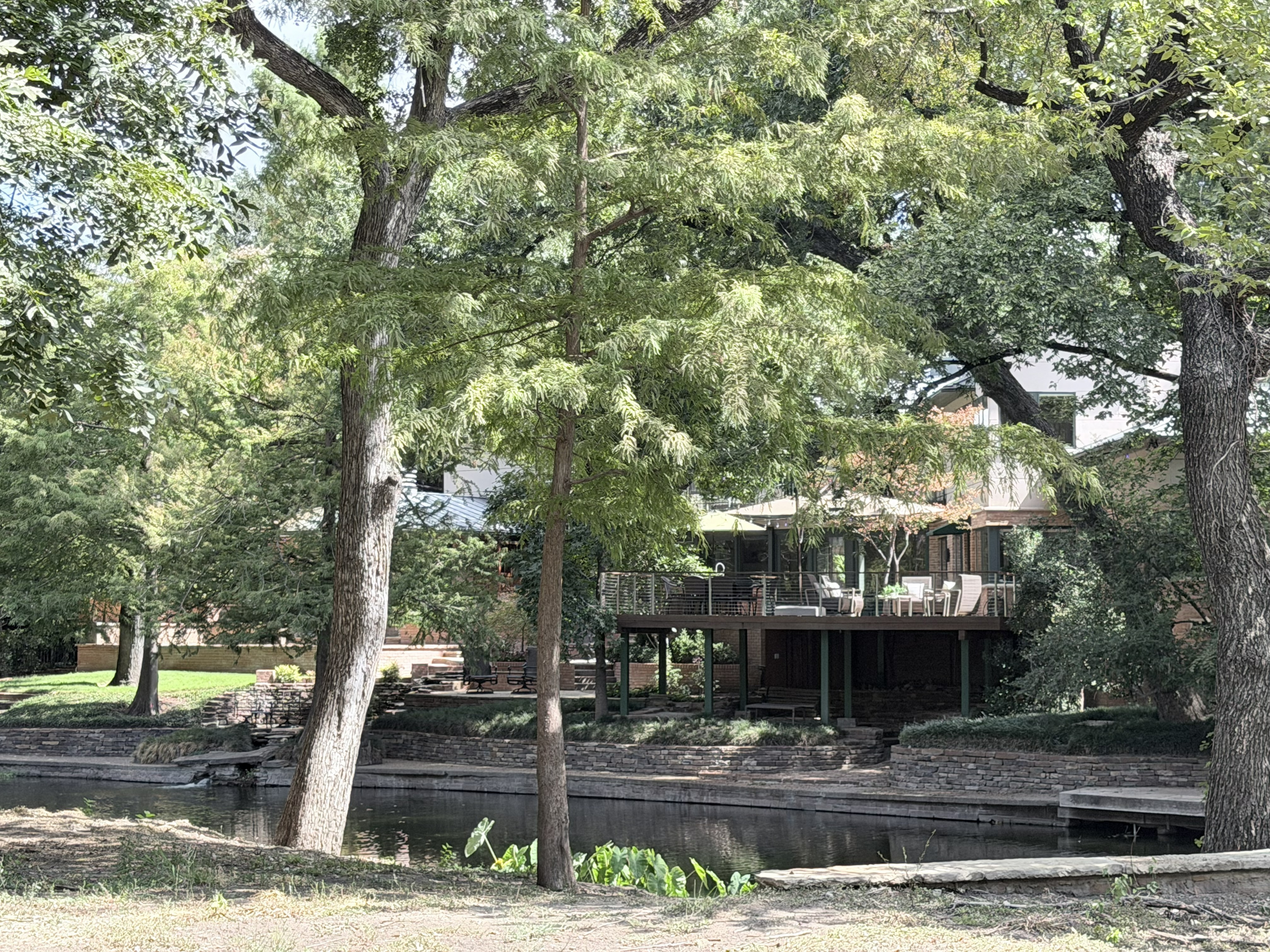
Highland Park's houses tend to get the attention. Drive through the town slowly, though, and something else begins to explain why it looks and feels the way it does.
The streets don't always behave as expected.
They curve. They split around landscaped spaces. Bridges appear between residential blocks. Turtle Creek slips in and out of view, sometimes running beside a park and sometimes disappearing behind houses and trees.
Then you reach Lakeside Drive, where the relationship becomes obvious. Water, parkland, mature trees, and residential architecture occupy the same landscape. It feels less like a park inserted into a neighborhood than a neighborhood that learned how to live around a creek.
The Creek Came First
Long before Highland Park existed, Turtle Creek was already cutting its path through this part of North Texas.
When Highland Park began developing in the early 20th century, the landscape became part of the town plan rather than something to be completely erased by it. Creeks, terrain, parks, landscaped boulevards, and residential streets developed in relationship to one another.
You can still read those decisions today.
Near Turtle Creek, the street pattern bends and adjusts. Lots can take on different shapes and orientations. Bridges become part of ordinary routes through town. Public green space repeatedly interrupts the residential landscape.
Move only a few blocks away and the pattern can change again.
It's one reason Highland Park can feel surprisingly varied for a town covering only a few square miles.
Lakeside Is Where It Comes Together
Lakeside Park is the clearest expression of that relationship.
The park follows Turtle Creek between Beverly Drive and Armstrong Parkway, with lawns, mature trees, walking paths, bridges, water, and the oversized teddy bear sculptures that have become one of Highland Park's more unexpected landmarks.
Across the street is another layer of the story.
Lakeside Drive contains some of the town's most substantial residential architecture, including houses from different periods of Highland Park's development. But the buildings aren't experienced in isolation. Parkland opens the view. Trees frame the houses. Water and topography add distance and depth.
It's difficult to separate the architecture from its setting.
The same house placed on a conventional residential block would be a different house.
Highland Park's Green Space Isn't Confined to One Park
Lakeside is the obvious landmark, but focusing only on it misses something important about Highland Park.
Green space is dispersed throughout the town.
Smaller parks, creek corridors, landscaped medians, traffic islands, and pockets of public space repeatedly appear among the residential streets. Some are destinations. Others are simply things you pass on the way to school, during a dog walk, or driving home.
That distinction matters to the experience of the place.
A neighborhood can have excellent parks without feeling particularly green between them. In Highland Park, landscape frequently enters the streets themselves.
Much of what we see today also took decades to develop. Trees that now form canopies over residential streets began much smaller. Landscaping matured. Houses came and went around it.
The original plan provided a framework. Time changed its scale.
The Streets Follow the Landscape
The relationship becomes particularly interesting around Turtle Creek.
Elevation shifts. Lots don't always conform to the same dimensions. A property may relate to parkland, water, a bridge, or an unusually wide stretch of public landscape in a way that isn't obvious from its address.
That's part of what distinguishes Lakeside Drive from Armstrong Parkway, or either of them from an interior Highland Park street.
They're all within the same tiny municipality. They don't live the same way.
This is also why Highland Park makes considerably more sense from the ground than it does on a map. On paper, Lakeside and Armstrong are simply streets. Drive them and the geography starts explaining the architecture, the lots, and even the way the houses present themselves to the public realm.
A Landscape With a Century to Mature
Established neighborhoods can create the illusion that they have always looked the way they do now.
Highland Park didn't.
The canopy grew. Gardens matured. Public landscaping evolved. Houses were built, altered, removed, and replaced. The relationship between the built and natural landscape accumulated slowly.
Turtle Creek is the exception.
It was here before Highland Park and became one of the organizing features around which part of the town developed.
More than a century later, that early relationship remains surprisingly easy to see. Follow the creek, cross one of the bridges, or look across Lakeside Park toward the houses beyond it and much of Highland Park's physical story is sitting in the same frame.
The creek came first.
The town grew around it.
Written and curated by Shay Lary
Global Real Estate Advisor, Christie’s International Real Estate | Lone Star