Experience Dallas
Highland Park vs. University Park
Same Schools, Very Different Feel
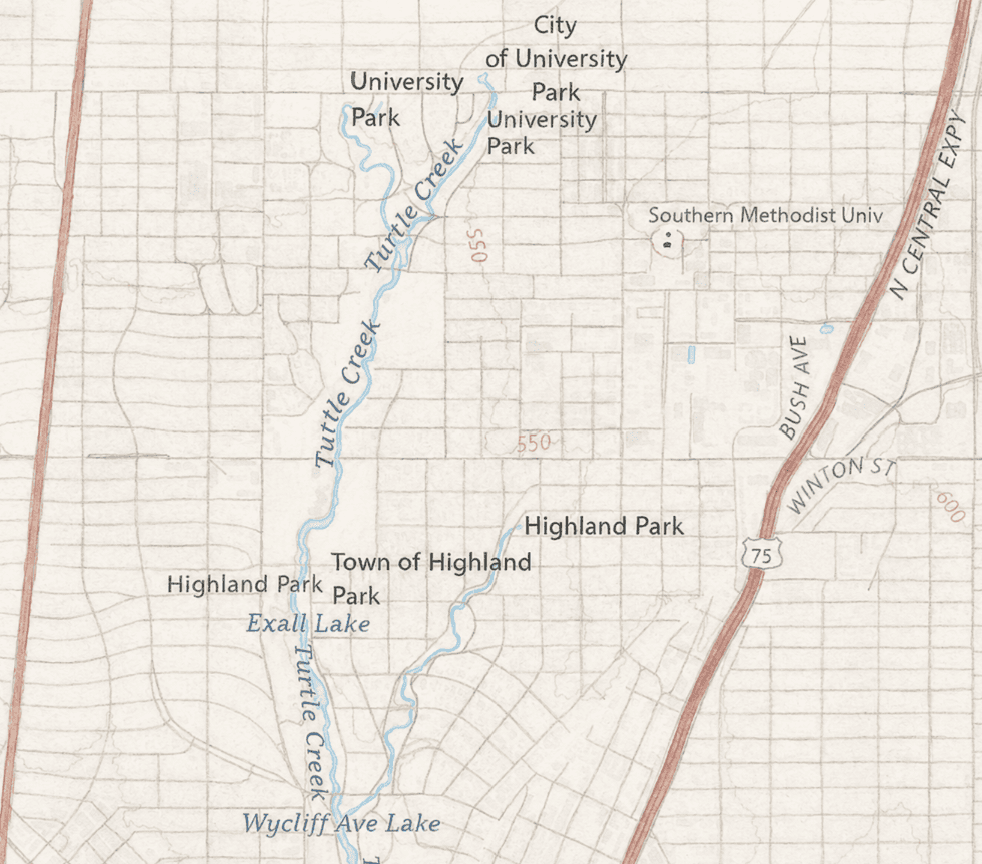
Highland Park and University Park are almost always introduced together. Collectively known as the Park Cities, the two independent municipalities sit side by side, share Highland Park ISD, and occupy one of the most recognizable residential areas in Dallas.
To someone relocating here, the distinction can initially seem almost academic. Spend time in both, though, and the differences become easier to see.
It's not really a question of which is better. It's about how each place lives.
Highland Park Begins With the Landscape
Turtle Creek winds through Highland Park, connecting parks, bridges, mature trees, landscaped medians, and some of the town's most recognizable residential streets. Lakeside Park is the obvious centerpiece, but the landscape influences much more than the park itself.
The housing is equally varied. Early 20th-century Mediterranean, Tudor, Georgian, and other historically influenced homes share the streets with architect-designed estates and substantial newer construction. Lots and houses vary considerably, but some parts of Highland Park offer an estate scale that becomes harder to find as you move north.
Then there are Highland Park Village and Dallas Country Club, two institutions that occupy a significant place in both the town's geography and its history.
Highland Park Village isn't simply a luxury shopping center nearby. It is woven into the neighborhood. Residents use the same courtyards and storefronts for coffee, dinner, errands, or a movie that draw visitors from across Dallas. Dallas Country Club occupies another substantial piece of the town.
Together with the parks, schools, churches, and municipal services, these places give Highland Park an unusually complete sense of place for such a small community.
University Park Has a Different Energy
Cross into University Park, and there is no dramatic dividing line. The houses don't suddenly change and the streets don't announce that you've entered another municipality.
But the rhythm does shift.
SMU is a large part of that. The university brings students, athletics, lectures, performances, the Meadows Museum, and the constant activity of a major campus embedded in a residential community.
Snider Plaza adds another dimension. Where Highland Park Village has evolved into an international luxury destination, Snider Plaza remains decidedly local: restaurants, shops, services, and everyday errands concentrated within a compact commercial district surrounded by residential streets.
University Park's parks are dispersed throughout the city as well. Curtis Park, Holmes Aquatic Center, Coffee Park, Caruth Park, Goar Park, and smaller green spaces become part of everyday routines depending on where you live. In some parts of University Park, a school, a park, Snider Plaza, or SMU can all be reached on foot or by bicycle.
The overall effect can feel a little more active and informal, particularly around the university and neighborhood commercial areas.
The Homes Tell Part of the Story
Buyers sometimes approach the Park Cities as though Highland Park and University Park were interchangeable because both provide access to HPISD.
The real estate is more nuanced than that.
Highland Park contains some of the Park Cities' largest estate properties, particularly around Turtle Creek, Lakeside Drive, Armstrong Parkway, Beverly Drive, and Dallas Country Club.
University Park is larger and offers a broader range of residential settings. There are substantial estates and architecturally significant homes here, too, alongside many blocks where houses sit closer together, and neighborhood activity is more visible from the sidewalk.
Within either city, however, the individual street matters.
Two homes only a few blocks apart can have very different lots, architecture, traffic patterns, walkability, and relationships to parks or commercial areas. "I want to live in the Park Cities" may narrow the map considerably, but it doesn't finish the search.
What They Share
The differences between Highland Park and University Park are real, but so is the connection between them.
Both are independent municipalities surrounded by Dallas, with their own local governments and city services. Their students largely move through the same school system. Families from both communities gather under the same Highland Park Scots banner, and schools, sports, churches, friendships, and traditions routinely cross the municipal line.
That's why "the Park Cities" is more than convenient real estate shorthand.
Highland Park tends to draw attention to its landscape, Turtle Creek, architecture, Highland Park Village, and the finite geography of a very small town. University Park brings SMU, Snider Plaza, an extensive network of parks and recreation, and a somewhat different residential rhythm.
Neither experience can be reduced to a price point or school ranking.
They're next-door neighbors with more than a century of interconnected history.
They just don't live quite the same.
Explore the Highland Park Neighborhood Guide →
Explore the University Park Neighborhood Guide →
Worth Sharing
Written and curated by Shay Lary
Global Real Estate Advisor, Christie’s International Real Estate | Lone Star