Lifestyle & News
The Rise of Y'all Street
Dallas has never struggled to attract business.
For decades, companies have relocated their headquarters here, drawn by a business-friendly environment, a central location, and a quality of life that continues to appeal to executives and their families.
But something different is happening.
Dallas isn't simply adding another corporate campus or another office tower to its skyline. It's quietly becoming one of the country's most significant financial centers.
Some have even started calling it "Y'all Street."
Whether that nickname becomes permanent is almost beside the point. The larger trend is unmistakable.
A growing number of the world's most influential financial institutions are choosing Dallas as a long-term investment—not simply for office space, but for talent, infrastructure, and future growth.
And while that may sound like a commercial real estate story, it has implications that reach far beyond downtown.
More Than Office Towers
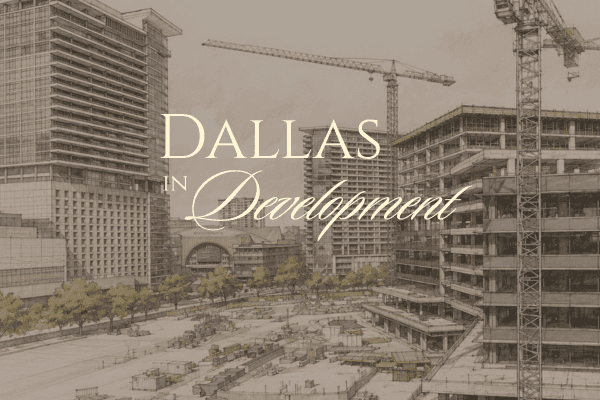
Standing in Victory Park today, it's easy to focus on the cranes surrounding Goldman Sachs' new campus.
It's an impressive project by any measure.
Yet the buildings themselves aren't the most interesting part of the story.
What matters is what they represent.
Goldman Sachs' investment signals confidence in Dallas as a global business destination. Add Bank of America's continued expansion, the arrival of the Texas Stock Exchange, UBS's growing presence, Scotiabank's operations, and the proposed Morgan Stanley regional hub, and a broader pattern begins to emerge.
Dallas isn't simply competing for headquarters anymore.
It's becoming part of the national conversation about the future of finance.
Why Dallas?
Every city wants investment.
Only a handful consistently earn it.
Dallas offers a combination that's increasingly difficult to replicate:
A deep and growing talent pool
A central location with national connectivity
Modern office developments capable of accommodating large employers
A business climate that encourages investment
An exceptional lifestyle that attracts and retains executive talent
Those advantages have been building for decades.
The financial industry is simply one of the latest sectors to recognize them.
Why This Matters for Residential Real Estate
This is where the story becomes personal.
When thousands of highly compensated employees relocate to a city, they don't just lease office space.
They look for neighborhoods.
They evaluate schools.
They discover restaurants and parks.
They shorten commutes.
They search for homes that align with the way they want to live.
Demand doesn't spread evenly across a city. It tends to concentrate around neighborhoods that already offer convenience, character, walkability, established communities, and enduring architectural appeal.
That doesn't mean every home suddenly becomes more valuable overnight.
It means the neighborhoods that consistently deliver these qualities often become even more desirable over time.
Looking Beyond the Headlines
Development stories often focus on construction timelines, square footage, and investment totals.
Those numbers certainly matter.
What interests me even more is what happens after the ribbon cutting.
How will these investments influence the neighborhoods surrounding Dallas' urban core?
Which communities will become increasingly attractive to relocating executives?
How will today's commercial developments shape tomorrow's residential market?
Those are the questions that matter to buyers, sellers, and anyone considering calling Dallas home.
A Dallas Curated Perspective
The rise of "Y'all Street" isn't ultimately about office towers.
It's about the evolution of a city.
Dallas has always reinvented itself—from oil and telecommunications to technology, healthcare, and corporate headquarters. Financial services may simply represent the next chapter in that story.
As someone who spends every day helping clients understand Dallas neighborhood by neighborhood, I believe these shifts are worth watching long before they're reflected in home prices or market statistics.
Because every new headquarters eventually becomes a neighborhood story.
And that's exactly the kind of story Dallas in Development was created to tell.