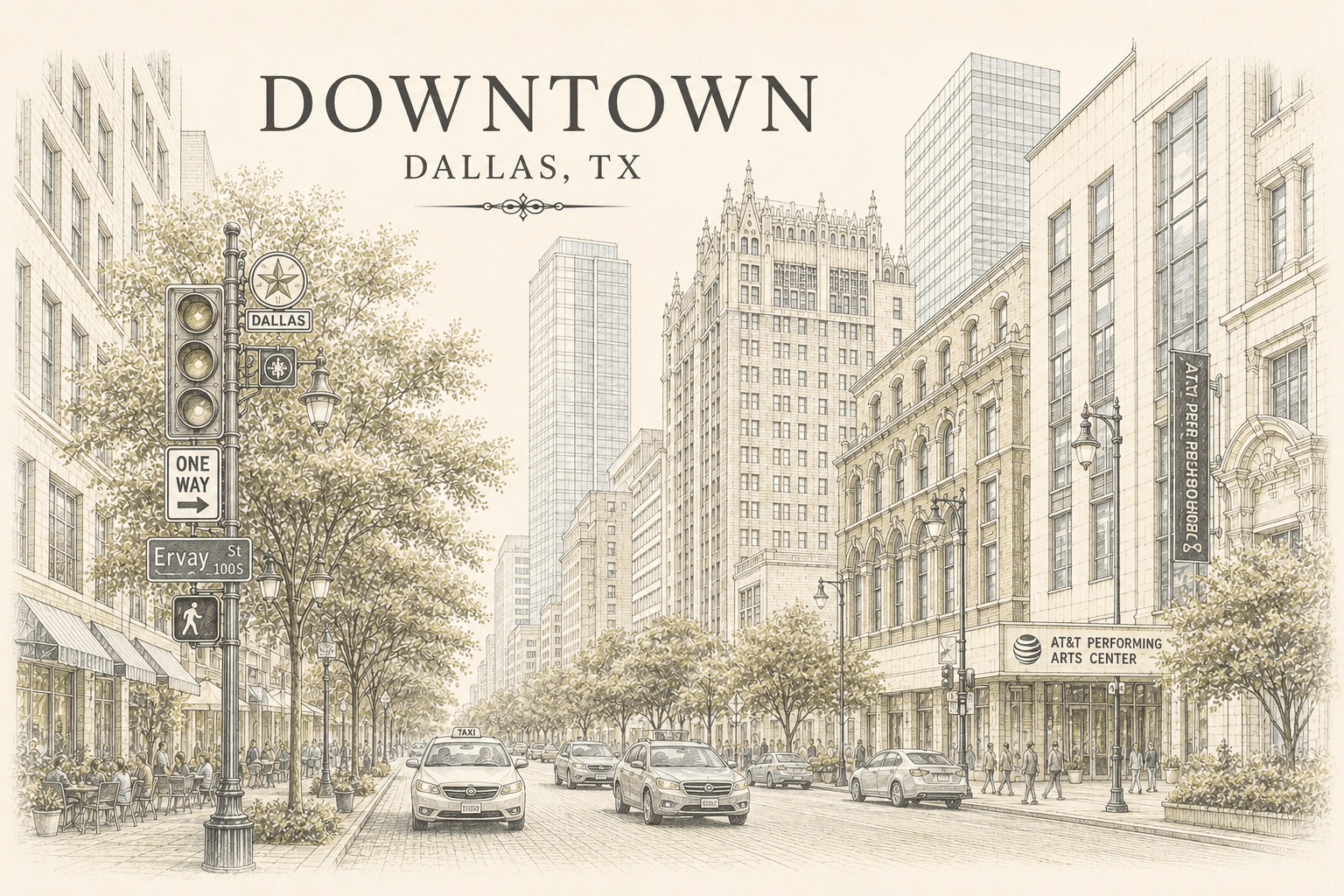
Central Dallas
Historic lofts, skyline towers, cultural landmarks, and several very different versions of living in the center of Dallas.
75201, 75202, 75219 (selected Downtown and Victory Park districts)
Walkable · High-Rise · Lock-and-Leave · Historic Lofts · Arts & Culture · Transit-Connected
Downtown Dallas
Downtown Dallas is easiest to understand as a collection of districts rather than one uniform neighborhood.
The Arts District, Victory Park, Main Street, the Farmers Market, the East Quarter, and the West End sit within a relatively compact urban core, but they offer noticeably different versions of city living. One address may place museums, performance halls, and Klyde Warren Park outside the front door. Another may come with a converted loft, a historic façade, and a view down Main Street. Farther southeast, townhomes and lower-scale residences around the Farmers Market create a more residential rhythm than the skyline might suggest.
In Downtown Dallas, the individual building and the surrounding few blocks matter as much as the neighborhood name.
That distinction is important. Downtown has become far more residential than its former office-district identity implies, but daily life still changes from block to block. Some pockets feel active well beyond the workday. Others remain quieter at night or depend more heavily on nearby districts for groceries and everyday errands. The right fit is rarely determined by the skyline view alone.
One Downtown, Several Ways to Live
The Arts District is Downtown's cultural and luxury-residential edge, bringing a small collection of condominium towers into immediate proximity to the Dallas Museum of Art, the Nasher Sculpture Center, the Meyerson Symphony Center, the AT&T Performing Arts Center, and Klyde Warren Park.
Victory Park offers a newer, more contemporary version of urban Dallas. High-rise residences surround American Airlines Center and connect easily with Uptown, the Katy Trail, Harwood, and the western side of Downtown. Event nights bring energy; on quieter days, the district feels more residential than its original entertainment-focused plan might suggest.
The Main Street District carries much of Downtown's architectural history. Former offices, banks, and commercial buildings have been converted into lofts, condominiums, apartments, and hotels, creating homes with details and floor plans that are difficult to reproduce in newer construction.
The Dallas Farmers Market introduces a different scale. Apartments, lofts, and fee-simple townhomes sit around the market and the Harwood Historic District, with Deep Ellum, Main Street, and the eastern edge of Downtown close at hand.
The East Quarter and West End help complete the picture. The East Quarter is an evolving bridge between Main Street, the Farmers Market, and Deep Ellum. The West End is more historic and visitor-oriented, with warehouse architecture, museums, transit access, and a smaller residential footprint.
Housing Stock
Downtown's for-sale housing is overwhelmingly condominium and townhome living. Purpose-built luxury towers, established high-rises, adaptive-reuse loft buildings, and newer attached townhomes all appear within the same broader market.
The differences extend well beyond age or price. Some buildings provide valet service, concierge staffing, pools, fitness centers, guest suites, and hotel-style amenities. Others offer a simpler ownership model built around space, architecture, or location. Parking may be assigned, deeded, leased, or limited. Outdoor space can range from a private terrace to a shared rooftop—or none at all.
Converted buildings deserve particular attention. Historic character may come with unusual layouts, concrete floors, exposed structure, large windows, or ceiling heights that newer buildings rarely duplicate. It may also bring building-specific considerations involving windows, mechanical systems, reserves, insurance, and future maintenance.
For buyers, this is a market where comparing two units by price per square foot alone can miss much of the story. Building operations, monthly ownership costs, parking, views, staffing, financial health, and the experience immediately outside the building all affect how a Downtown home lives.
Daily Life Downtown
Downtown offers some of Dallas' strongest walkability and transit access, but it is not uniformly car-free. Residents near Main Street, the Arts District, or Victory Park can reach restaurants, parks, offices, cultural venues, and major events on foot. DART Rail, the M-Line Trolley, the Dallas Streetcar, and the Trinity Railway Express expand that reach beyond the neighborhood.
Everyday convenience remains more uneven. The Farmers Market brings produce, specialty foods, prepared meals, and a regular weekend rhythm to the southeastern side of Downtown, while a full-service Tom Thumb sits near Victory Park's northern edge. Depending on the building, residents may still drive or arrange delivery for a larger grocery run.
That mix is part of Downtown's current identity. It is no longer simply the place Dallas goes to work, attend a concert, or see a game. It is a collection of real residential pockets—each with its own architecture, pace, and practical tradeoffs.
Considering a move to this neighborhood or exploring more like it? I help buyers and sellers understand the streets, homes, and market nuances that shape each part of Dallas.
Schools
Dallas ISD
Downtown Dallas is served by Dallas ISD, with public-school assignments determined by the specific property address. Because the guide spans several districts—and neighborhood, ZIP-code, and attendance-zone boundaries do not align neatly—buyers should verify the current assignment directly with the district for any individual residence.
Choice and Magnet Programs
Downtown is also home to Dallas ISD campuses that serve students through application-based or specialized programs, including Downtown Montessori at Ida B. Wells Academy and Booker T. Washington High School for the Performing and Visual Arts. Their proximity does not mean automatic neighborhood admission, so families should review the current program and enrollment requirements separately from the zoned-school assignment.
Parks & Outdoor
Klyde Warren Park — Built over Woodall Rodgers Freeway, the park connects the Arts District with Uptown and brings lawns, food, programming, and public gathering space to Downtown's northern edge.
Pacific Plaza — A central urban park with mature trees, open lawn, and room for everyday use between Main Street and the Arts District.
Carpenter Park — A redesigned park on Downtown's eastern edge, with walking paths, recreation, public art, and an important connection toward Deep Ellum and East Dallas.
Harwood Park — A neighborhood-scaled park serving the Farmers Market and Harwood Historic District, with play areas, open space, and an increasingly residential setting around it.
Main Street Garden and West End Square — Two smaller parks woven directly into their surrounding districts, offering green space, seating, and programming within the street grid.
Downtown's parks are not simply amenities. Together, they have begun to make the urban core feel more connected and more livable between destinations.
Shopping & Retail
Shopping Downtown is dispersed rather than concentrated in one traditional retail district.
Main Street and the urban core mix independent shops, services, hotel retail, and design-oriented destinations with the architecture of Dallas' former commercial center. The Dallas Farmers Market adds produce, specialty foods, local vendors, and everyday gathering space, while Victory Park provides convenient access to the Tom Thumb on Field Street and additional shopping in nearby Uptown.
For larger retail errands, most residents still look beyond Downtown to Uptown, the Design District, the Park Cities, or NorthPark Center. Downtown's strength is less about having every store within its boundary and more about placing several of the city's most useful urban districts within a short drive, rail ride, or walk.
Market At a Glance
CONDOMINIUM & TOWNHOME SALES · JAN–JUN 2026
$526,250
MEDIAN CLOSED PRICE
$326
MEDIAN PRICE / SF
79
MEDIAN DAYS ON MARKET
96.4%
SALE-TO-LIST
38
CLOSED SALES
FROM DALLAS CURATED
Worth Reading

Downtown Dallas Isn’t One Neighborhood
Downtown Dallas vs. Uptown: Two Versions of Urban Living

Buying a Condo or Loft in Downtown Dallas
NEIGHBORHOOD ARCHIVE
Continue Exploring
EDITOR’S TOP 3
Where to eat first in this neighborhood

Italian-American
Urban Italia
A polished, high-energy take on Italian-American comfort food in Victory Park, pairing wood-fired pizzas and housemade pastas with red-sauce classics and a cocktail program designed for a full night out.
Housemade pasta, wood-fired pizza, and elevated Italian-American classics

Contemporary American / Farm-to-Table
Café Momentum
One of downtown’s most meaningful tables—a polished New American restaurant that doubles as a paid culinary internship and support program for justice-involved youth. The mission brings people in, but the thoughtful seasonal cooking gives them a reason to return.
Seasonal New American cooking paired with a nationally recognized youth-development mission
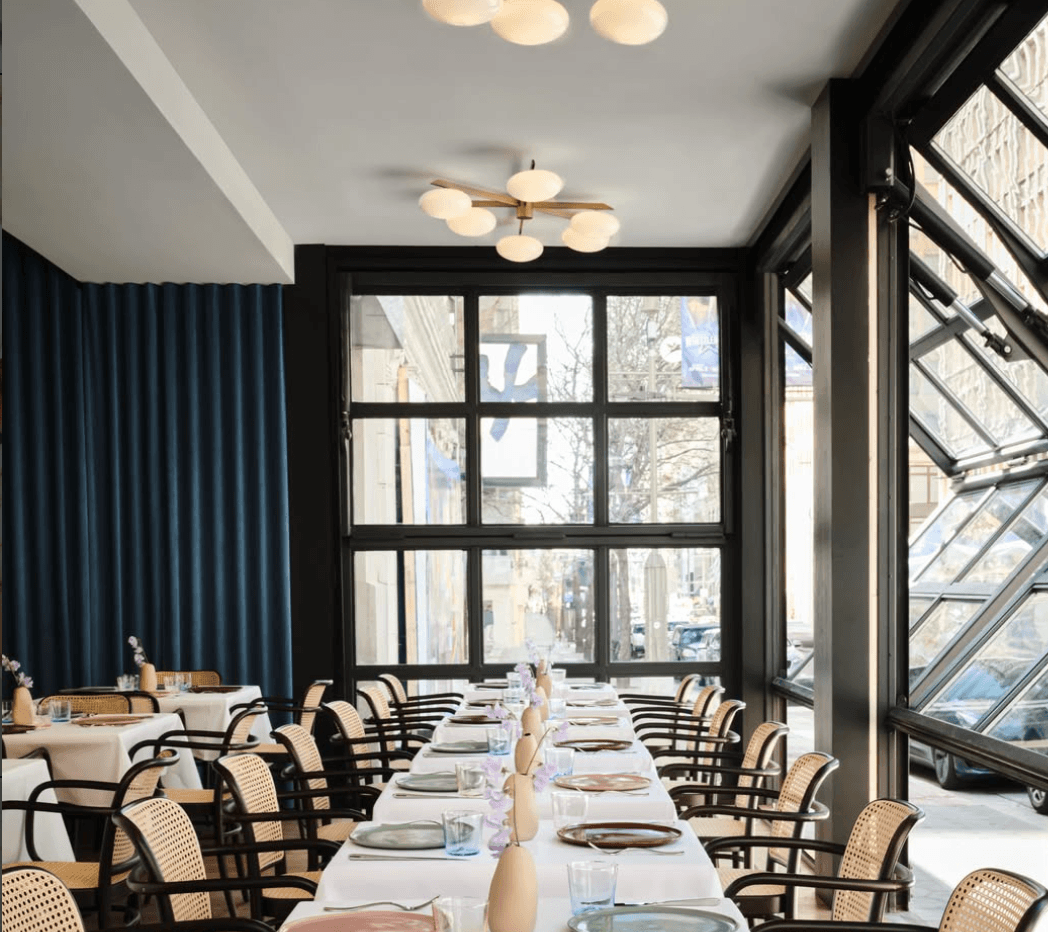
Italian / Pizza
Sassetta
An Italian destination inside The Joule, with housemade pastas, blistered pizzas, regional wines, and a dining room that feels stylish without slipping into formality. It works as easily for aperitivo as it does for a lingering downtown dinner.
Housemade pasta, blistered pizza, and an especially polished modern-trattoria setting
Want to see more of the editor’s favorites?
Walk Score & Drive Time
90–93 in the Downtown core — among Dallas' most walkable settings, though everyday convenience varies by district and block.
walk score note
Within Downtown; most district-to-district trips are a few minutes by car, rail, trolley, or on foot.
to downtown
Buyer questions
Frequently asked questions for this neighborhood
Is Downtown Dallas one neighborhood?
What areas are included in the Downtown Dallas guide?
Is Deep Ellum part of Downtown Dallas?
What kind of homes are available in Downtown Dallas?
Is Downtown Dallas walkable?
Can you live in Downtown Dallas without a car?
What's the median home price in Downtown Dallas?
How is Downtown Dallas different from Uptown?
Does Downtown Dallas have grocery shopping?
What school district serves Downtown Dallas?