Dallas Intelligence
The Rise of Y'all Street
The Rise of Y’all Street
Dallas has never had much trouble attracting business.
Companies have been moving headquarters, divisions, and regional offices here for decades. The reasons are familiar: a central location, a large labor pool, comparatively friendly operating costs, and an airport that makes it possible to reach most of the country without losing a day to travel.
What is happening now feels a little different.
Dallas is building a much deeper presence in finance. Not through one dramatic relocation, but through a series of investments that are beginning to reinforce one another.
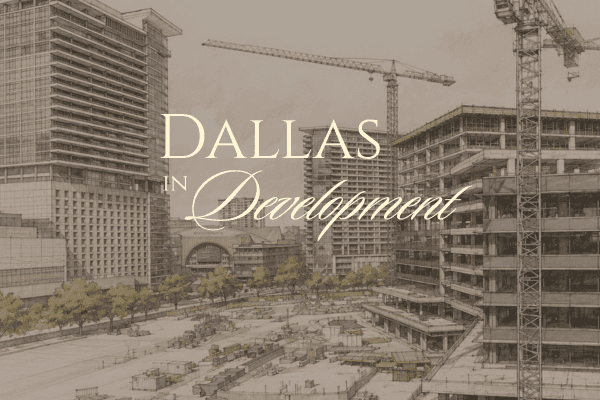
Goldman Sachs is building an 800,000-square-foot campus at NorthEnd, near Victory Park, designed to accommodate more than 5,000 employees. The Texas Stock Exchange is now operating from Dallas. Nasdaq Texas has launched as a Texas-domiciled exchange and dual-listing venue. Other financial institutions continue to expand their offices and teams across the city.
Somewhere along the way, people started calling it “Y’all Street.”
The nickname is catchy. It is also easy to overstate.
Dallas is not replacing New York as the center of American finance. That is not really the point. The more useful question is whether Dallas is becoming a more important financial center than it was before.
The answer appears to be yes.
More Than Another Corporate Campus
Standing near Victory Park, the most visible evidence is the Goldman Sachs campus rising at NorthEnd.
It is an unusually large commitment, particularly at a time when companies are still reconsidering how much office space they need. But the significance of the project is not limited to its square footage.
A campus of that scale brings people, recruiting, professional services, and long-term institutional investment with it. It also places a major financial employer near Uptown, downtown, the Katy Trail, and several of Dallas’ most established residential neighborhoods.
That does not mean 5,000 new people will arrive in Dallas all at once. Some employees already live here. Some positions will be filled locally. Others may relocate over time.
Still, the campus adds weight to a pattern that is becoming harder to dismiss.
Dallas is no longer simply a place where financial firms maintain regional offices. It is becoming a place where they are willing to build substantial operations.
Why Dallas Keeps Making the List
There is no single reason Dallas continues to attract this kind of investment.
The city offers a large professional workforce, extensive air connectivity, and enough land to create modern offices at a scale that would be difficult in many older financial centers. Texas also continues to position itself as a business-friendly state.
Then there is the part that rarely appears in an economic-development announcement: people have to want to live here.
For employers recruiting nationally, the residential side of Dallas matters. Executives and employees can choose a high-rise near the office, a walkable neighborhood close to restaurants and parks, or a more traditional home within a relatively short drive.
Those choices are one of the city’s real advantages. Dallas does not offer a single version of city life.
When an Employment Story Becomes a Neighborhood Story
Large corporate investments eventually affect more than office buildings.
Employees begin comparing commute times. They consider schools, parks, restaurants, housing styles, and how much of their day they are willing to spend in a car. A downtown or Uptown office may make one neighborhood newly practical for a household while taking another out of consideration.
That does not mean nearby home values automatically rise. Corporate announcements do not erase interest rates, housing supply, pricing, or the individual condition of a property.
They do, however, change the way people evaluate location.
That is where the Y’all Street story becomes relevant to residential real estate. The important question is not whether every new financial job produces another home sale. It is how a growing concentration of employers may influence where people want to live—and which neighborhoods make their Dallas lives easier.
A Story Still Being Written
Dallas has reinvented its economy before.
Oil helped shape one era. Telecommunications, technology, healthcare, and corporate relocations shaped others. Finance may become another important layer rather than a replacement for everything that came before it.
There is still plenty we do not know. Some projects remain under construction. Some corporate plans may change. The larger economic effects will take years to become clear.
But the direction is worth watching.
Y’all Street is not just a nickname attached to a few office towers. It describes a city taking on a larger role in the movement of money, companies, and talent.
And sooner or later, every one of those decisions reaches beyond the office.
It becomes a Dallas neighborhood story.
Company and project information reflects publicly available announcements as of August 2026.
Worth Sharing
Written and curated by Shay Lary
Global Real Estate Advisor, Christie’s International Real Estate | Lone Star