Dallas Intelligence
Preston Hollow Isn't One Neighborhood
Why the Name Only Tells You Part of the Story
Tell someone in Dallas you live in Preston Hollow, and they will have a general idea of where you mean.
They still may have very little idea of what your street looks like. For the broader overview—schools, parks, shopping, and current market statistics—start with the Preston Hollow Neighborhood Guide.
That's because Preston Hollow isn't one uniform neighborhood. It's a broad collection of residential pockets that developed at different times, on different street patterns, with different lot sizes, architecture, and rhythms of daily life.
For someone relocating to Dallas, this can be confusing. Two houses may both appear under “Preston Hollow” in a real estate search and offer almost nothing alike.
Understanding those differences is where the neighborhood starts to make sense.
Old Preston Hollow sets the scale
Old Preston Hollow is the version outsiders are most likely to imagine.
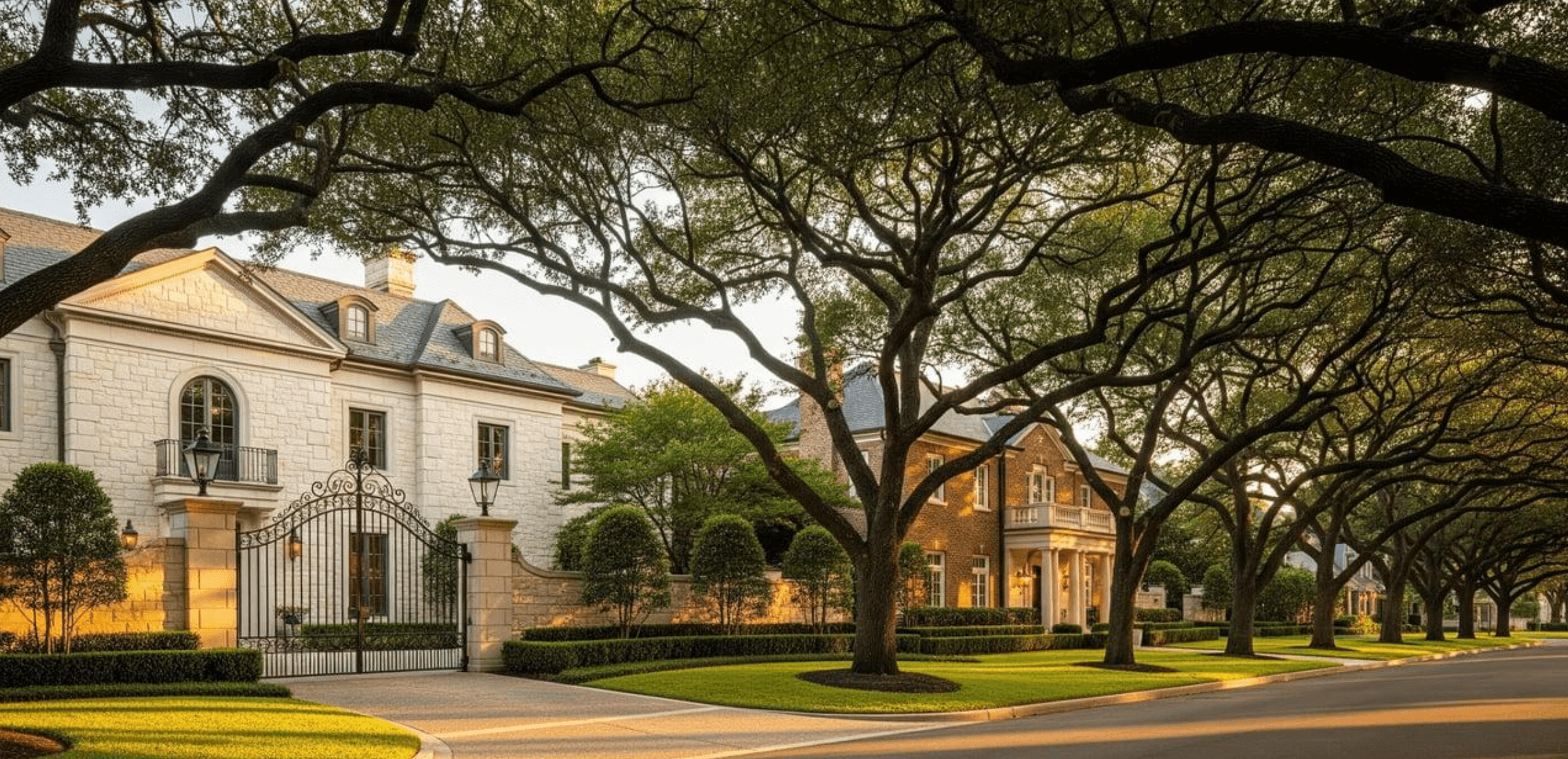
This is where the roads begin to curve, lots become unusually large, and houses retreat behind mature trees, gates, walls, and long drives. The street pattern reflects the area's early development rather than the conventional grid found across much of Dallas.
Some properties feel less like city lots than private grounds.
This is also where land becomes a particularly important part of the real estate equation. A house can be renovated, expanded, or replaced. A great piece of land on one of these established streets is considerably harder to reproduce.
But Old Preston Hollow is only one version of Preston Hollow.
That landscape makes more sense once you know why Old Preston Hollow developed so differently from the neighborhoods around it.
Elsewhere, the neighborhood becomes more recognizably residential
Move into other sections, and the scale changes.
You'll find 1950s and 1960s ranch houses, traditional two-stories, renovated mid-century homes, newer custom construction, and original houses that have survived while much of the block has changed around them.
Lots may still be generous by central Dallas standards, but they aren't necessarily estate-sized. Streets become straighter. Houses sit closer to the road. Neighbors are more visible.
For many buyers, that's a feature rather than a compromise.
Someone may love Preston Hollow's location and trees but prefer a street where children ride bikes and neighbors regularly see one another outside. Someone else may want as much privacy as the city can reasonably provide.
Both can find Preston Hollow appealing. They probably won't choose the same part of it.
Architecture changes block by block
The neighborhood's long period of development is visible in its houses.
Preston Hollow includes early estate homes, Texas regional architecture, work by significant Dallas architects, postwar ranch houses, mid-century modern residences, French and English-influenced traditional homes, Mediterranean designs, and a growing amount of contemporary new construction.
Sometimes several of those appear on the same street.
There is no prescribed Preston Hollow look, and that's part of its identity. Unlike neighborhoods where architectural consistency creates the visual character, Preston Hollow's character often comes from the land, trees, setbacks, and scale of the street itself.
Those layers tell their own story. The architecture of Preston Hollow traces how early estates, Dallas modernism, postwar ranch houses, and contemporary construction came to share the same broader neighborhood.
Location within Preston Hollow changes daily life, too
A house near Preston Center lives differently from one farther north near the Northaven Trail.
Proximity to St. Mark's is different from proximity to Hockaday or Jesuit. Access to the Tollway may matter enormously to one household and barely at all to another.
Even a few blocks can change which major road you naturally use, where you buy groceries, how you approach school drop-off, and whether walking or biking ever becomes part of your routine.
Geography is only part of it. Living in Preston Hollow looks more closely at how those differences translate into everyday life.
This is why I rarely think a buyer should begin with the question, Do I like Preston Hollow?
The better question is:
Which Preston Hollow fits the way I want to live?
The house is only part of the decision
This becomes particularly important when comparing properties.
A beautifully renovated house may sit on a less compelling lot. An older home may occupy the better street. New construction may offer everything a buyer wants inside but sacrifice mature landscaping or backyard depth. A house that seems like the obvious winner online can feel entirely different once you understand its surroundings.
Preston Hollow rewards buyers who look beyond the listing.
Drive the street.
Notice the setbacks.
Look at what's being renovated and what's being torn down.
Pay attention to the trees, neighboring houses, traffic patterns, school routes, and how the block feels at different times of day.
Because in Preston Hollow, the neighborhood name gets you into roughly the right part of Dallas.
The street is where the real decision begins.
Written and curated by Shay Lary
Global Real Estate Advisor, Christie’s International Real Estate | Lone Star