Experience Dallas
Architecture of Bluffview: When the Land Designs the House
There isn't one Bluffview house.
That's part of what makes the neighborhood worth looking at closely.
Drive a few streets, and you may pass an early estate, a romantic Charles Dilbeck design, a low-slung midcentury house, a renovation that has evolved over decades, and a contemporary home built within the last few years.
The styles change.
The land doesn't.
And that may be the better way to understand Bluffview architecture.
Start With the Site
When Bluffview Estates opened in 1924, architects weren't working with neat rows of identical rectangular parcels.
They were dealing with trees, a winding creek, elevation changes, and odd-shaped lots.
Early architects Harre Bernet and Ralph Bryan designed around those conditions rather than eliminating them. That approach established something that still feels fundamental to the neighborhood: the site matters.
A house in Bluffview may sit high above the street or well below it. A property can narrow, widen, slope, or turn unexpectedly. Mature trees may influence where additions make sense. Creek and ravine conditions can create opportunities for privacy and views while adding another layer of complexity to the property.
Here, architecture has always had something to respond to.
The Architects Who Saw the Possibilities
That terrain attracted some significant names in Texas architecture.
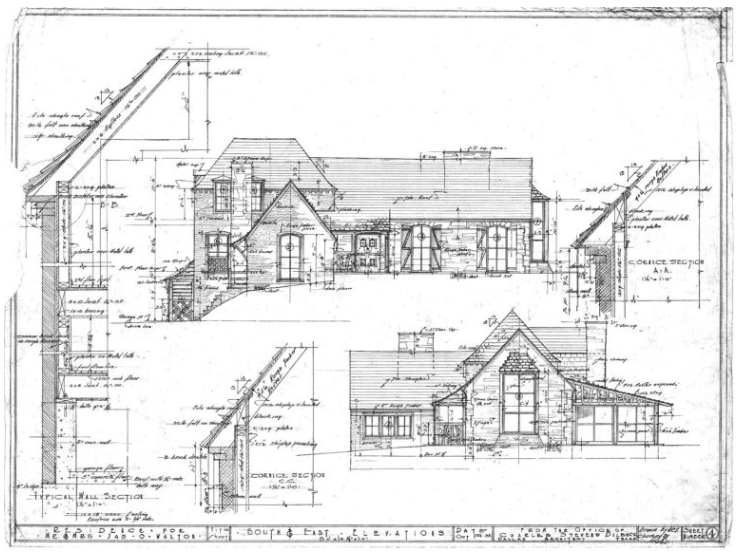
Charles Dilbeck designed several houses in Bluffview. His work is known for an idiosyncratic regional style that could borrow from European cottages, ranch architecture, rustic materials, oversized chimneys, handcrafted details, and forms that feel almost storybook without fitting neatly into a single category.
Bluffview was particularly suited to it.
O'Neil Ford also designed one of his early homes in the neighborhood for artist Jerry Bywaters. Ford would go on to become one of the most important figures in Texas architecture, known for an approach rooted in regional materials, craftsmanship, and climate.
Their houses weren't interchangeable.
What they shared was an ability to let architecture belong to a place.
A Neighborhood That Kept Evolving
Bluffview didn't stop building after its early architectural period.
That matters too.
Midcentury houses arrived. Existing homes were expanded and renovated. Some original properties disappeared. New custom houses took their place.
Today, the neighborhood is architecturally mixed in a way that can feel surprisingly organic. There isn't a conservation district requiring every house to conform to a particular historic vocabulary, nor is Bluffview dominated by a single generation of new construction.
The result can be uneven. It can also be fascinating.
On one street, the conversation may be about preserving an architecturally significant older home. A few doors away, a contemporary house may use glass, concrete, and a dramatically different design language to engage with essentially the same landscape.
The Best Houses Understand Where They Are
That's the thread worth following.
Bluffview's architectural story isn't really about old versus new.
It's about whether a house understands its site.
A successful historic home may have been positioned decades ago to capture breezes, views, shade, or the natural grade. A successful contemporary house can accomplish the same thing with entirely different materials.
The interesting question isn't whether it looks like the house next door.
In Bluffview, it probably shouldn't.
The more useful question is whether the architecture and the land make sense together.
Because here, the lot was never just the place where someone put the house.
It has always been part of the design.
Continue exploring: Read about Bluffview's beginnings as a 215-acre dairy farm, or explore the complete Dallas Curated Bluffview Neighborhood Guide.
Written and curated by Shay Lary
Global Real Estate Advisor, Christie’s International Real Estate | Lone Star